 May, 24 2026
Full Mouth Implant Cost Estimator (UK)
Configuration
Estimated Cost Breakdown
*Prices are estimates based on 2026 market data. Actual costs may vary by surgeon and specific clinical needs.
Imagine waking up with a mouth full of sore gums, missing teeth, or dentures that slip every time you smile. It is a scenario many people in the UK face as they age or deal with severe decay. The question on your mind is likely simple but heavy: Can I have all my teeth removed and replaced with implants in the UK? The short answer is yes. But the long answer involves navigating a complex mix of private healthcare costs, surgical procedures like All-on-4, and strict NHS guidelines. This guide breaks down exactly how this transformation works, what it costs in 2026, and whether the National Health Service will cover it.
Understanding Full Mouth Dental Implants
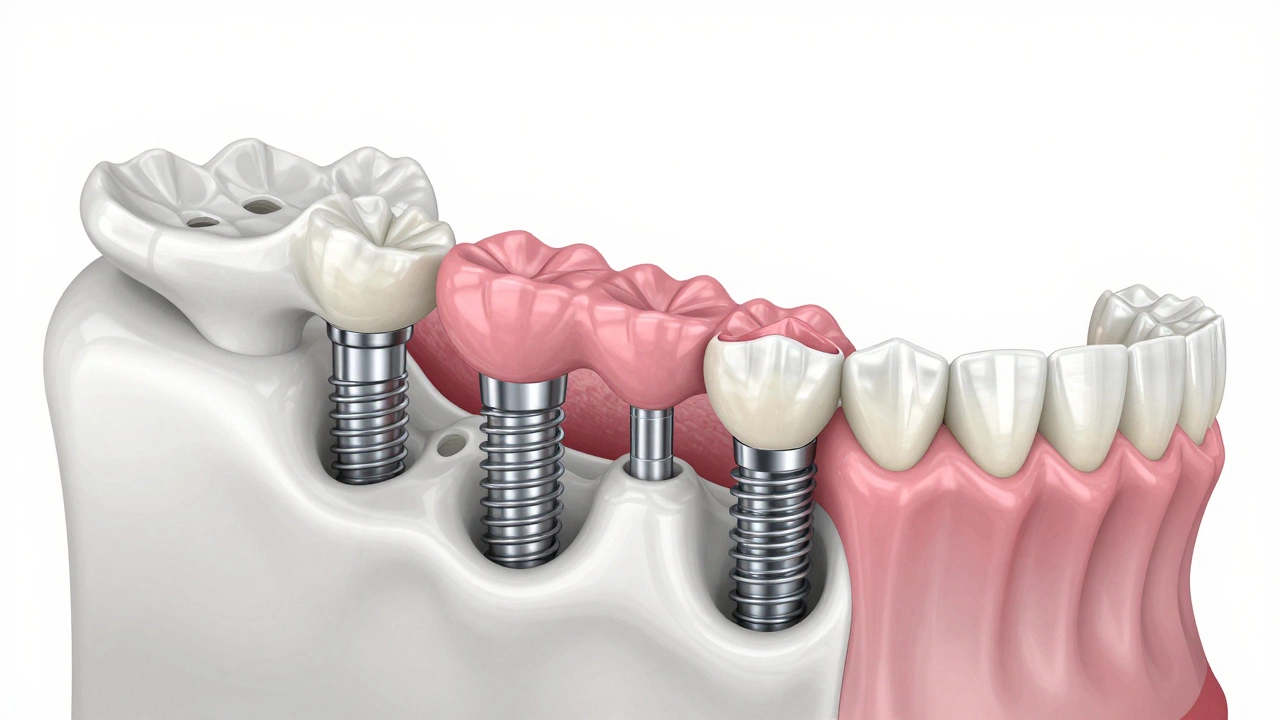
When we talk about replacing all your teeth, we are usually referring to two main approaches: individual implant-supported crowns for every tooth, or fixed hybrid bridges supported by fewer implants. The latter is far more common because it is cost-effective and structurally sound. You do not need an implant under every single crown. Instead, surgeons place four to six titanium posts into your jawbone. These posts fuse with the bone over time-a process called osseointegration. Once healed, a permanent bridge of ten to twelve artificial teeth is attached to these anchors.
This method is often marketed as All-on-4, which is a surgical technique where a full arch of teeth is supported by just four strategically placed implants. This approach allows patients to leave the clinic with a new set of teeth on the same day as surgery, even if they had all their remaining teeth extracted during the procedure. It eliminates the need for removable dentures, restoring chewing power and confidence instantly.
The NHS Stance: Will They Pay For It?
Here is the hard truth most patients discover early on: the NHS (National Health Service) rarely funds full mouth dental implants. In the UK, the NHS operates on a principle of clinical necessity. If you can function adequately with conventional dentures, the NHS will provide those at a standard Band 2 or Band 3 charge. Dentures are considered sufficient for basic oral health and nutrition.
Implants are generally classified as cosmetic or elective enhancements within the NHS framework. There are very narrow exceptions. If you have suffered significant trauma to your jaw, have a congenital condition that prevents denture retention, or have medical issues like severe allergies to acrylics used in dentures, you might qualify. However, these cases are reviewed by specialist panels and are the exception, not the rule. For the vast majority of people seeking full mouth rehabilitation due to decay, gum disease, or age-related loss, the path forward is through private dental care.
The Surgical Journey: From Extraction to New Teeth
Getting all your teeth removed and replaced is not a one-day appointment in the traditional sense. It is a structured journey that typically spans three to six months. Here is what the timeline looks like in a typical UK private clinic:
- Initial Consultation and CT Scan: Your dentist will take 3D scans of your jaw to assess bone density. If your bone has shrunk due to long-term tooth loss, you may need bone grafting before implants can be placed. This adds time and cost to the process.
- Tooth Extractions: Any remaining compromised teeth are removed. This is done carefully to preserve as much healthy bone as possible. Sometimes, implants are placed immediately after extraction (immediate loading), but this depends on your bone quality.
- Implant Placement: Under local anesthesia or sedation, the surgeon places the titanium fixtures into your upper and/or lower jaw. The gums are stitched closed around them.
- Healing Period (Osseointegration): This is the critical phase. It takes three to six months for the bone to grow around the implants. During this time, you wear temporary dentures so you are never without teeth.
- Final Restoration: Once healing is complete, impressions are taken. A lab crafts your permanent bridge. You return to the clinic to have the final prosthesis screwed onto your implants.
The entire process requires patience. Rushing the healing phase can lead to implant failure. A good surgeon will prioritize the biological success of the fusion over speed.
Cost Breakdown: What Do Full Mouth Implants Cost in the UK?
Price is the biggest barrier for most patients. Costs vary significantly depending on the city, the experience of the surgeon, and the materials used. In London and the Southeast, prices tend to be higher due to overheads. In regions like the North or Midlands, you might find more competitive rates.
| Service | Lower Jaw Only | Upper Jaw Only | Both Jaws (Full Mouth) |
|---|---|---|---|
| Consultation & CT Scan | £150 - £300 | £150 - £300 | £150 - £300 |
| Tooth Extractions | £200 - £600 | £200 - £600 | £400 - £1,200 |
| Bone Grafting (if needed) | £500 - £1,500 | £500 - £1,500 | £1,000 - £3,000 |
| Implant Surgery (All-on-4) | £8,000 - £12,000 | £8,000 - £12,000 | £16,000 - £24,000 |
| Temporary Dentures | £500 - £1,000 | £500 - £1,000 | £1,000 - £2,000 |
| Final Permanent Bridge | £3,000 - £5,000 | £3,000 - £5,000 | £6,000 - £10,000 |
| Total Estimated Range | £12,000 - £19,000 | £12,000 - £19,000 | £24,000 - £38,000+ |
Note that some clinics offer "package deals" that bundle extractions, implants, and the final bridge into a single price. Always ask for a detailed written quote that includes follow-up visits and potential complications. Hidden costs often arise from unexpected bone grafting needs or sinus lifts for upper jaw implants.
Choosing the Right Clinic and Surgeon
Not all dentists perform full mouth reconstructions. This is advanced oral surgery. You should look for a clinic with specialists in oral surgery or prosthodontics. Check if the surgeon is registered with the General Dental Council (GDC) and has specific training in implantology.
Ask these questions during your consultation:
- How many All-on-4 or full mouth cases have you performed?
- Do you handle the surgery and the final restoration in-house, or do you outsource parts of the process?
- What brand of implants do you use? (Reputable brands include Nobel Biocare, Straumann, and Zimmer Biomet.)
- What is your warranty policy? Most reputable clinics offer a five-to-ten-year warranty on the workmanship and a lifetime warranty on the titanium fixture itself.
Avoid clinics that pressure you into immediate payment without a thorough diagnostic review. Ethical practitioners will tell you if you are not a suitable candidate due to smoking, uncontrolled diabetes, or poor bone density.

Risks and Long-Term Maintenance
Dental implants are not indestructible. While they have a success rate of over 95%, risks exist. Infection, nerve damage, and implant rejection are possibilities, though rare with experienced surgeons. Smoking is a major risk factor; it restricts blood flow and significantly increases the chance of failure. Many surgeons require patients to quit smoking for several weeks before and after surgery.
Long-term maintenance is crucial. Unlike natural teeth, implants cannot get cavities. However, they can suffer from peri-implantitis, a gum disease that attacks the bone supporting the implant. You must brush, floss (using special tools provided by your dentist), and attend check-ups every six months. With proper care, full mouth implants can last twenty years or more, making them a worthwhile investment compared to replacing dentures every five to seven years.
Financing Options in the UK
Since the NHS does not cover this, financing is essential for most. Many UK dental practices partner with finance companies like PayPal Credit, Gem Finance, or Zopa. These services often offer interest-free periods ranging from six to twenty-four months. Alternatively, some clinics allow you to pay in monthly installments directly. Always read the terms carefully to understand any setup fees or late payment penalties.
Is it painful to have all my teeth removed and replaced with implants?
The surgery itself is painless because you are under local anesthesia or sedation. Afterward, you will experience swelling and discomfort for a few days, manageable with prescribed painkillers. Many patients report less pain than they expected, especially compared to the chronic discomfort of ill-fitting dentures.
How long do I have to wait before eating normally?
You will eat a soft diet for the first week or two while your gums heal. Once your temporary teeth are fitted, you can chew softer foods. After the final permanent bridge is placed, you can gradually return to a normal diet, including harder foods like apples and steak, though you should still avoid extreme forces like biting ice.
Can I get dental implants if I smoke?
Smoking increases the risk of implant failure significantly. Many surgeons will refuse to treat smokers or will require you to quit for a specific period before and after surgery. If you smoke, be honest with your dentist so they can assess your risk accurately.
What happens if an implant fails?
If an implant fails to integrate with the bone, it must be removed. The site is allowed to heal, and a new implant may be placed later, sometimes requiring additional bone grafting. Reputable clinics include replacement costs in their warranties if failure occurs due to surgical error.
Are there cheaper alternatives to full mouth implants in the UK?
Yes. Conventional dentures are the cheapest option and are available via the NHS. Hybrid options like implant-retained overdentures (where dentures snap onto two implants) are also less expensive than full fixed bridges. These offer stability without the high cost of a full All-on-4 reconstruction.
